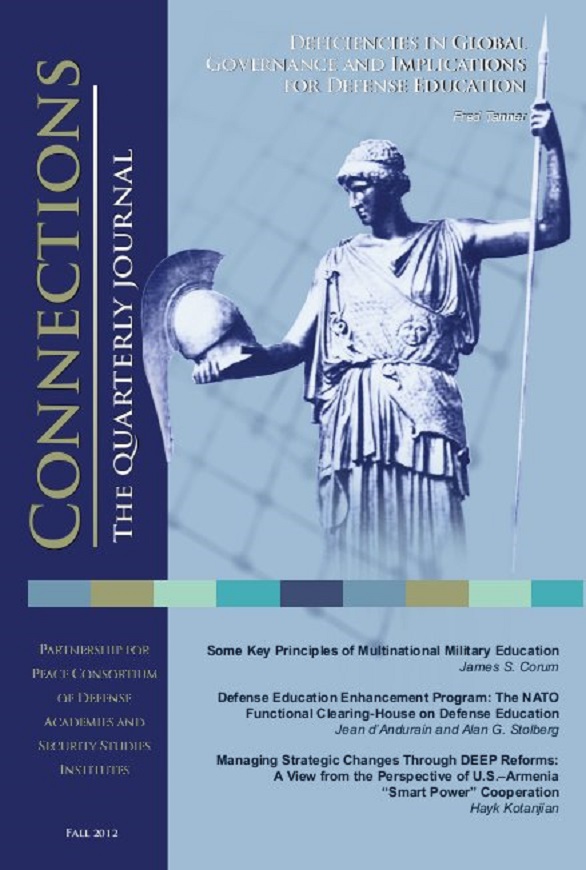
Connections
Contents
The Persistent Demand for Defense Institution Building
NATO’s Defense Institution Building and Projecting Stability: Current Priorities and Activities
Defense Institution Building in the U.S. Context
NATO’s Defense Institution Building in the Age of Hybrid Warfare
Defense Against Negative Strategic Communications
Defense Institution Building from Above? Lessons from the Baltic Experience
Ukraine’s Security Sector Reform: Is Ukraine Taking Western Advice?
Defence Institution Building in Ukraine at Peace and at War
Defense Education Enhancement Program in Ukraine: The Limits of NATO’s Education Program
Introduction
In the immediate aftermath of the Cold War period in the 1990s, NATO was highly engaged with the armed forces of a number of states of the former Soviet Union and the Eastern Europe-based Warsaw Pact. The intent of this engagement was to assist their militaries in the process of Western-style transformation as part of their national preparation for interoperability and potential integration with NATO. One of the major supporting components for this NATO process was the development of regionally focused “clearing-houses.”
The Merriam-Webster Dictionary defines a clearing-house as “a central agency for the collection, classification, and distribution, especially of information;…. [a] channel for distributing information or assistance.” In the case of NATO, these regional clearinghouses were to serve an integration function for the NATO member states to provide specific support for the transformation of militaries in former Soviet republics and Warsaw Pact countries. The NATO member states would participate in these periodic meetings to identify the required assistance needs on the part of the non-member target states that were not being filled (gaps that existed in the support process), and to determine which member nations would be willing to support efforts to meet those needs through the execution of various programs and individual events.
Previous Issue
 Since the fall of the Soviet Union, Russia has been unprecedented in its embrace of modern technology for the execution of its foreign policy and intelligence operation. This article examines Russia’s relationship to the internet and computer technology, beginning with the early 1990s and detailing the growth of technology’s popularity with the Rus...
Read More
Since the fall of the Soviet Union, Russia has been unprecedented in its embrace of modern technology for the execution of its foreign policy and intelligence operation. This article examines Russia’s relationship to the internet and computer technology, beginning with the early 1990s and detailing the growth of technology’s popularity with the Rus...
Read More