Connections
Contents
The Persistent Demand for Defense Institution Building
NATO’s Defense Institution Building and Projecting Stability: Current Priorities and Activities
Defense Institution Building in the U.S. Context
NATO’s Defense Institution Building in the Age of Hybrid Warfare
Defense Against Negative Strategic Communications
Defense Institution Building from Above? Lessons from the Baltic Experience
Ukraine’s Security Sector Reform: Is Ukraine Taking Western Advice?
Defence Institution Building in Ukraine at Peace and at War
Defense Education Enhancement Program in Ukraine: The Limits of NATO’s Education Program
Introduction
Those contributing to international peace and stability act in an ever-changing, increasingly complex and inter-connected global environment. The international security landscape has changed considerably during the last twenty years, with important power shifts in international affairs, an acceleration of globalization dynamics, the spread of modern information technologies, and a diversification of powerful actors in world politics. In addition, a multitude of transnational security challenges—ranging from the proliferation of weapons to organized crime, including the trafficking of human beings, the security implications of migration, and the challenges of information and cyber security—are on the agenda.
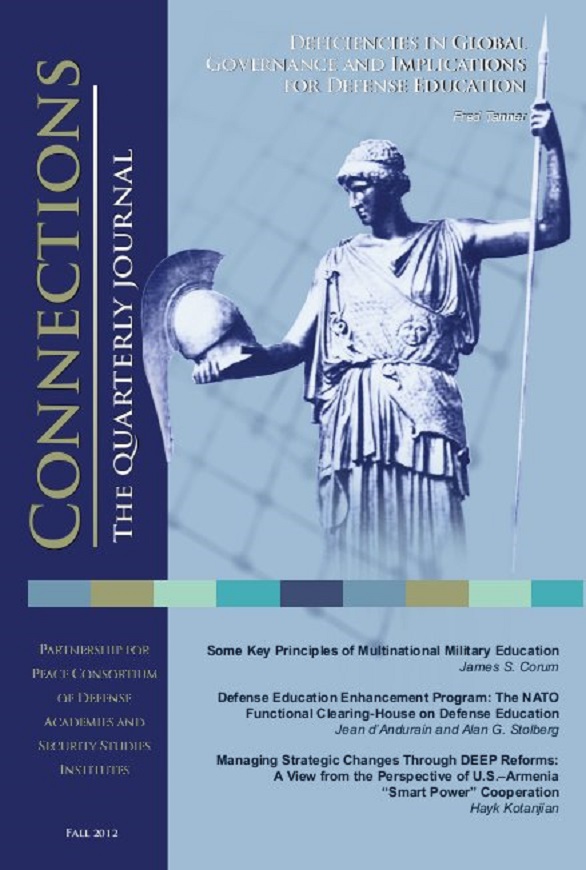
Global governance, which is understood here as cooperative arrangements between various international actors—states, international and regional organizations, as well as actors from the private sector and civil society communities—to manage global processes under conditions of globalization and in the absence of a world government, is still weak when it comes to adapting to these developments. Significant deficits in global governance with respect to issues of peace and international security exist today, and will most likely continue to exist in the future. A key consequence is the continuous presence of insecurity and disorder. In such situations of uncertainty, there is a need for leadership and close cooperation among partners. Education will be crucial in enabling the armed forces to fulfill their role in this environment. Thus, leadership skills, political awareness, and versatility will all be important elements of defense education. The global governance deficit requires us to better understand and deal with the changes in the international security landscape, including changing patterns of armed conflict and other forms of violence, the increasing threat to our financial and economic security, and the development and spread of new technologies. All these factors determine our security and defense thinking.
Previous Issue
 Since the fall of the Soviet Union, Russia has been unprecedented in its embrace of modern technology for the execution of its foreign policy and intelligence operation. This article examines Russia’s relationship to the internet and computer technology, beginning with the early 1990s and detailing the growth of technology’s popularity with the Rus...
Read More
Since the fall of the Soviet Union, Russia has been unprecedented in its embrace of modern technology for the execution of its foreign policy and intelligence operation. This article examines Russia’s relationship to the internet and computer technology, beginning with the early 1990s and detailing the growth of technology’s popularity with the Rus...
Read More