Connections
Contents
Karachi: Organized Crime in a Key Megacity
Global Dimensions of Organized Crime and Ways of Preventing Threats at International Level
Transnational Organized Crime – Latvian Challenges and Responses
Maritime Piracy as a Form of Organized Crime: A Strategic Management Approach
Cyberspace as the Environment Affected by Organized Crime Activity
The Mobilization and Recruitment of Foreign Fighters: The Case of Islamic State, 2012–2014
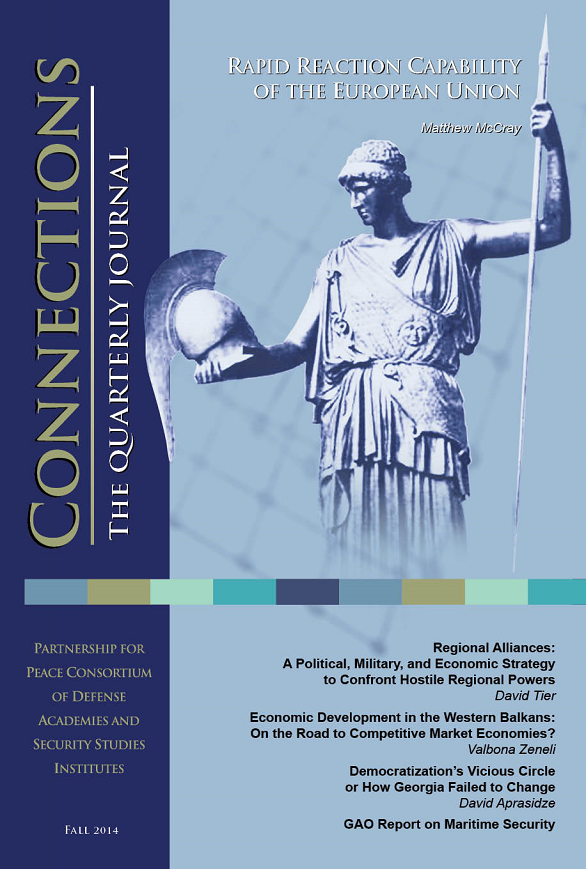
Today, more than ever, economic security is the main challenge facing the Western Balkans. Poverty, unemployment and inequality threaten the everyday security of average citizens in the region. Indirectly affected by the world economic recession through trade and finance spillover channels and strong dependence linkages with European Union markets, this region became highly vulnerable, falling into a double dip recession. The economic downturn has worsened socio-economic conditions, diminishing consumers’ confidence in markets, socially dividing the societies in terms of income and wealth levels, declining living standards and shaking social foundations, and threatening the hopes of eventual convergence with advanced countries. To reverse the downhill slide, the Western Balkans need to change gears, revising the model of growth by accelerating socio-economic reforms and speeding up measures to develop its economy. In desperate need of modernization, institutional transformation and sustained economic growth, countries should rely on deeper regional cooperation and integration with the EU as the foremost option for positive development. The most important driver of growth will be the catch up with technologies and market-friendly institutions of the advanced countries.
Previous Issue
 Advances in sensors, communications, computing, nano- and bio-technologies, along with new strategies and operational concepts, challenge our policy-making capacity. The Spring 2016 issue of Connections presents the Emerging Security Challenges Working Group of the PfP Consortium and reflections of some of its members on the security and policy imp...
Read More
Advances in sensors, communications, computing, nano- and bio-technologies, along with new strategies and operational concepts, challenge our policy-making capacity. The Spring 2016 issue of Connections presents the Emerging Security Challenges Working Group of the PfP Consortium and reflections of some of its members on the security and policy imp...
Read More