
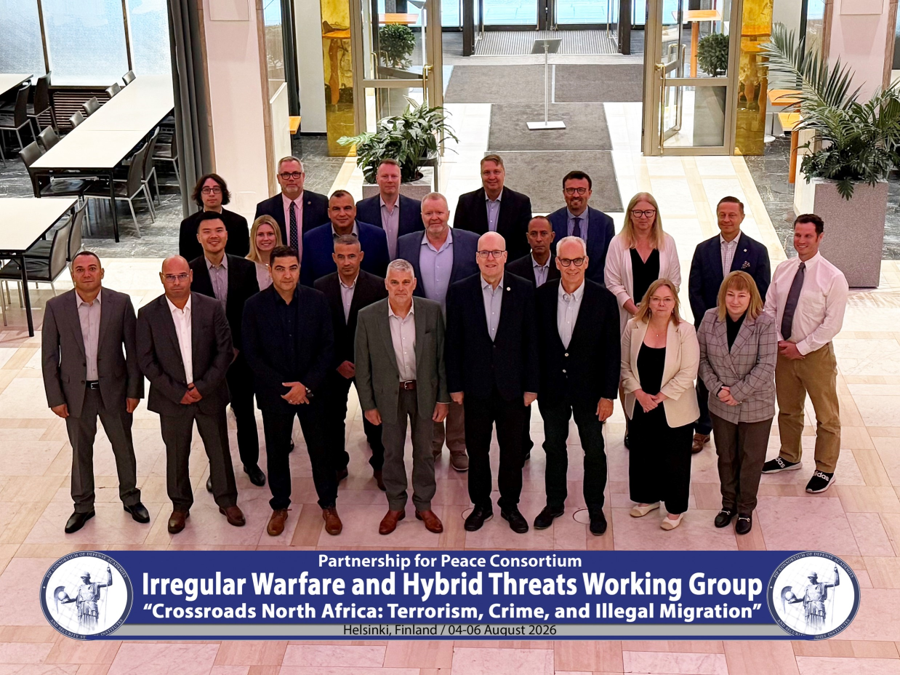
From August 4-6, 2026, the Partnership for Peace Consortium’s (PfPC) Irregular Warfare and Hybrid Threats Working Group, led by Dr. Kevin D. Stringer and Maj. Bill Song, met in Helsinki, Finland to examine the theme of “Crossroads North Africa: Terrorism, Crime and Illegal Migration.” The workshop gathered 21 academics, practitioners, and analysts from Finland, the United States, Tunisia, Germany, and Moldova to explore how Islamist terrorism, organized crime, and illegal migration unite in North Africa, affecting both European and NATO security. Beyond assessing the threats, the workshop served as an ideal setting for building relationships across participating states and among professionals, while enabling the open exchange of ideas and views on hybrid warfare, special operations forces (SOF), and counterterrorism.
Confronting Hybrid Threats in North Africa
Discussions throughout the event underscored the argument that instability in North Africa is driven not by a single challenge, but by the convergence of multiple threats and actors. Participants highlighted the dangerous nexus between Islamist terrorism, organized crime, and illegal migration, while noting that coercive activities by Russia and China further exacerbate an already complex security environment.
A central focus of the Working Group’s deliberations was the evolving nature of hybrid threats, defined as hostile actions that operate below the threshold of conventional warfare and deliberately exploit ambiguity to hinder attribution and response. Topical highlights included the migration-related tensions surrounding Ceuta and the Morocco-Spain border, the vulnerability of critical undersea infrastructure in the Mediterranean, and Tunisia's evolving counterterrorism strategy. Particularly for Tunisia, participants noted that the country's adaptive and proactive approach to counterterrorism through its SOF has contributed significantly to regional stability and continues to evolve in response to the volatile security dynamics across the Sahel and wider North African region.
Toward a Coordinated Response
During the event’s final day, the Working Group identified several priority areas for further research and future publications, including policy papers and short research articles. Participants reached broad consensus on the need to strengthen both maritime and land border surveillance and situational awareness; to further explore the role of Tunisian SOF as a regional center of excellence in countering emerging security threats; and to refine the often-overlapping concepts of gray-zone activities, irregular warfare, and hybrid threats. Working Group members volunteered to lead research efforts in each of these areas, ensuring that the dialogue initiated during the workshop will continue through collaborative analysis and practical policy recommendations. Overall, the workshop advanced the Partnership for Peace Consortium's mission of strengthening defense education and security-sector capacity among partner nations while fostering a trusted international network of defense educators, practitioners, and policy experts.
Previous News

Belgrade, Serbia, May 18-22, 2026 – The 25th Annual Conference of the Euro-Atlantic Conflict Studies Working Group (CSWG) of the PfP Consortium of Defense Academies and Security Studies Institutes was held under the theme “When the Guns Fall Silent… Cha