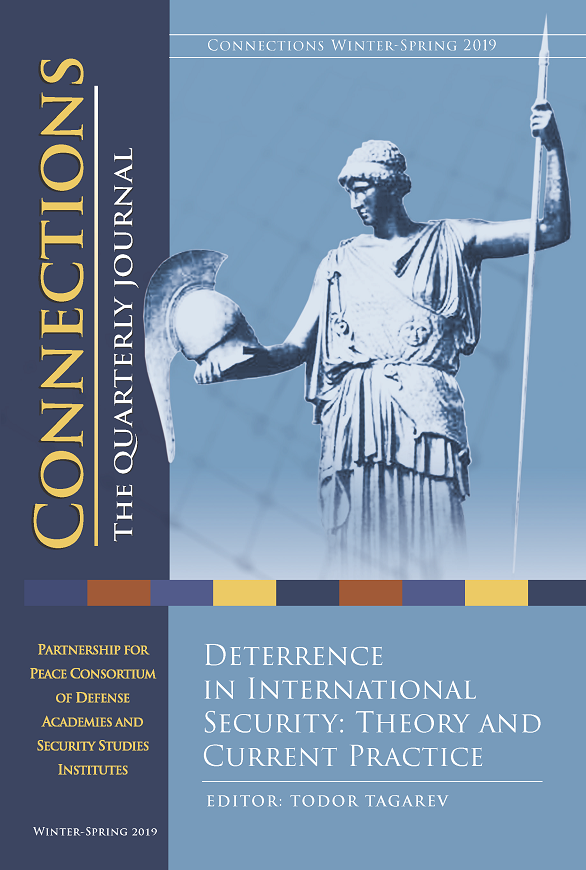
Connections
Contents
Emerging Security Challenges: An Introduction
Policy and the Internet of Things
Industry and Policy: Partnerships in Disruptive Times
Nanotechnology and Global Security
Hybrid Warfare and the Changing Character of Conflict
Making Sense of Hybrid Warfare
Abstract:
This article explores the continuities and changes between Cold War deterrence concepts and approaches and those being employed on NATO’s Eastern flank today. It is argued that classic approaches to deterrence, curated in a rich Cold War intellectual tradition, have been clearly on display in NATO’s responses to Russian aggression and threats, and it is possible to understand the decisions being made in Brussels and Alliance capitals through a consideration of such classical deterrence concepts as deterrence by denial and deterrence by punishment or direct versus extended deterrence. Concepts like these and others explored here remain useful. Nevertheless, important changes in the scope and nature of the threat must be considered, especially as this pertains to non-military aspects of deterrence and so-called hybrid or ‘gray-zone’ threats. This will require a merging of traditional concepts of deterrence with the more recent focus on developing a comprehensive approach to contemporary security challenges.
Previous Issue
 The Winter 2016 issue of Connections presents original articles on Russia's hybrid warfare toolset and its Soviet predecessors, the crisis in Ukraine, caused by the annexation of Crimea and the Kremlin-backed separatist forces in South-Eastern Ukraine, the enduring validity of Clausewitz's "On War" for modern conflict, and a review of university pr...
Read More
The Winter 2016 issue of Connections presents original articles on Russia's hybrid warfare toolset and its Soviet predecessors, the crisis in Ukraine, caused by the annexation of Crimea and the Kremlin-backed separatist forces in South-Eastern Ukraine, the enduring validity of Clausewitz's "On War" for modern conflict, and a review of university pr...
Read More