Connections
Contents
Karachi: Organized Crime in a Key Megacity
Global Dimensions of Organized Crime and Ways of Preventing Threats at International Level
Transnational Organized Crime – Latvian Challenges and Responses
Maritime Piracy as a Form of Organized Crime: A Strategic Management Approach
Cyberspace as the Environment Affected by Organized Crime Activity
The Mobilization and Recruitment of Foreign Fighters: The Case of Islamic State, 2012–2014
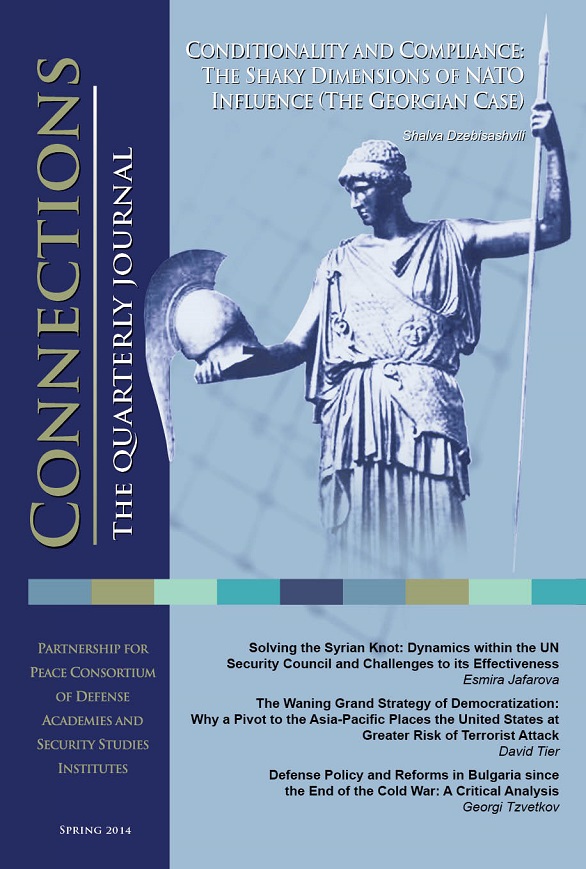
After the disintegration of the communist system in Eastern Europe the former communist countries had to make an unprecedented transition to a “normal” society. Having been diverted from their natural path of development, with limited private property and political rights, these countries had to once again begin following the European path of development.
Transforming the defense sectors in these societies was a crucial challenge. Yet there were complications in the sphere of defense transformation because of the overlapping of three transitions. The first was the shift from armies established as support for the communist regime to professional military organizations subject to civilian control. The second was the transition from mass conventional armies that were established to fight in World War III, which was never waged, to militaries that were relatively limited in their number of troops, the main purpose of which is to participate in a broad spectrum of operations beyond national boundaries. The third transition was that from a reliance on large quantities of Soviet equipment—most of it relatively cheap and easy to produce and maintain—to advanced, high-quality (and expensive) Western equipment. These transitions took place in a context of economic crises (of different magnitude) caused by the clash between planned economies and free market realities, when there were still groups in society that were not willing to give up the communist system easily.
Bulgaria was one of the states that faced the steepest challenges. The supporters of the communist regime were many and they were strong. There were, however, objective limitations to Bulgaria’s transition as well – the economy was not competitive enough, and the country had to cope with the burden of significant loans. In the military sphere, an additional challenge was what many considered as Bulgaria’s “natural” distrust for Turkey, along with strong pro-Russian affiliations.
Despite that, Bulgaria has become part of the European Union, and its armed forces are constantly increasing their preparedness to operate jointly with the armies of NATO and the EU member states. Even though Bulgaria is not the best example of how defense transformation should be carried out, its experience can be a valuable source of lessons for other states facing similar challenges.
Previous Issue
 Advances in sensors, communications, computing, nano- and bio-technologies, along with new strategies and operational concepts, challenge our policy-making capacity. The Spring 2016 issue of Connections presents the Emerging Security Challenges Working Group of the PfP Consortium and reflections of some of its members on the security and policy imp...
Read More
Advances in sensors, communications, computing, nano- and bio-technologies, along with new strategies and operational concepts, challenge our policy-making capacity. The Spring 2016 issue of Connections presents the Emerging Security Challenges Working Group of the PfP Consortium and reflections of some of its members on the security and policy imp...
Read More