Connections
Contents
Karachi: Organized Crime in a Key Megacity
Global Dimensions of Organized Crime and Ways of Preventing Threats at International Level
Transnational Organized Crime – Latvian Challenges and Responses
Maritime Piracy as a Form of Organized Crime: A Strategic Management Approach
Cyberspace as the Environment Affected by Organized Crime Activity
The Mobilization and Recruitment of Foreign Fighters: The Case of Islamic State, 2012–2014
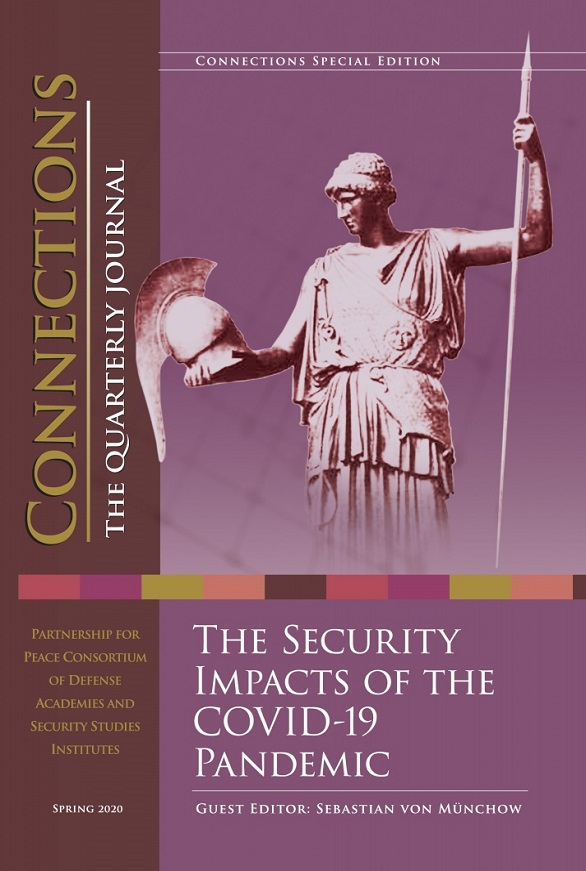
Soon after the first instance of COVID-19 in Central Asia was recorded in March 2020 in Kazakhstan, the government took immediate steps to introduce containment and mitigation measures. As cases of COVID-19 appeared soon after in Uzbekistan, Kyrgyzstan, and later in Tajikistan, the governments swiftly responded, instituting emergency measures, empowering law enforcement and medical authorities to implement a broad range of counter-infection mitigation measures to protect public health. Cross-border travel restrictions were imposed. Lockdowns and sheltering-in-place restrictions were imposed in most major cities and curfews were enforced. Routine commercial air flights were cancelled or significantly reduced in international airports and many domestic airports. New levels of visa restrictions were implemented in all the Central Asian countries. The initial infection containment measures were highly successful in curtailing the early spread of Covid-19. But governments immediately confronted a broad range of social and economic difficulties brought on by Covid-19. The sudden interruption of typical earnings and livelihoods for many people, the disruption of commercial supply chains, the cratering of commodity prices, and, for Kyrgyzstan and Tajikistan in particular, the loss of migrant labor opportunities and remittances, combined with other consequences of Covid-19 to produce a region-wide economic catastrophe. The pandemic called for immediate steps on the part of all the government of the region and focused attention on addressing the long-term social, economic, and even regional political implications.
Previous Issue
 Advances in sensors, communications, computing, nano- and bio-technologies, along with new strategies and operational concepts, challenge our policy-making capacity. The Spring 2016 issue of Connections presents the Emerging Security Challenges Working Group of the PfP Consortium and reflections of some of its members on the security and policy imp...
Read More
Advances in sensors, communications, computing, nano- and bio-technologies, along with new strategies and operational concepts, challenge our policy-making capacity. The Spring 2016 issue of Connections presents the Emerging Security Challenges Working Group of the PfP Consortium and reflections of some of its members on the security and policy imp...
Read More