Connections
Contents
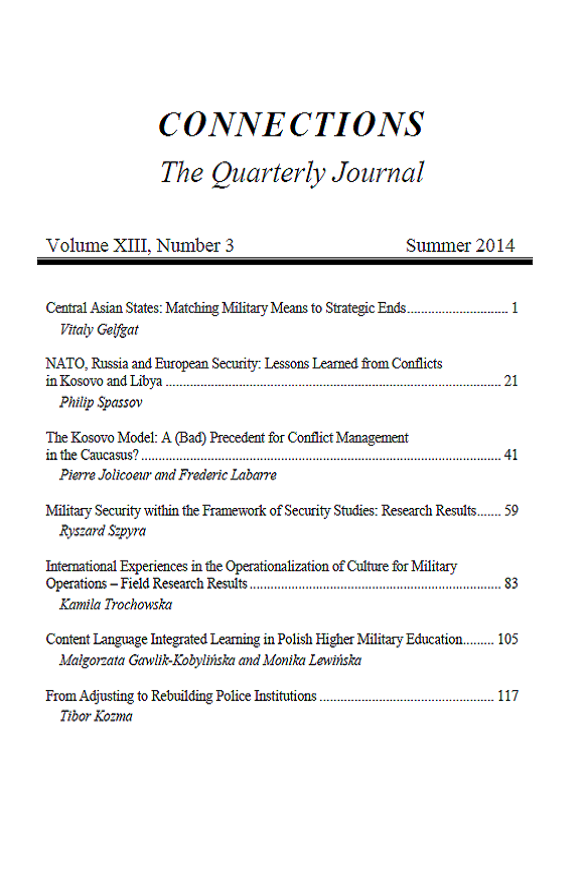
Karachi: Organized Crime in a Key Megacity
Global Dimensions of Organized Crime and Ways of Preventing Threats at International Level
Transnational Organized Crime – Latvian Challenges and Responses
Maritime Piracy as a Form of Organized Crime: A Strategic Management Approach
Cyberspace as the Environment Affected by Organized Crime Activity
The Mobilization and Recruitment of Foreign Fighters: The Case of Islamic State, 2012–2014
Abstract: Over the past two decades of independent history, the Central Asian states (Kazakhstan, Kyrgyzstan, Tajikistan, Turkmenistan and Uzbekistan) have developed pragmatic and largely non-ideological national security strategies rooted in their perceptions and prioritization of the complex regional realities. The states’ attempts to match their military and security services capabilities to handle a variety of external and internal security challenges highlights the fact that the Central Asian states regard these capabilities as critical
elements of hard power. At the same time, while often utilized to help quell various sources of domestic instability, all Central Asian militaries have lacked up-to-date operational experience. A review of their tactical proficiency in dealing with internal conflicts shows that although Kazakhstan and Uzbekistan have contained socio-political unrest better than Kyrgyzstan and Tajikistan, all the states struggled to reform and adapt their armed forces to successfully deliver on their doctrinal obligations. This is because they have remained largely outside of contemporary international military interventions such as Operation Iraqi Freedom, the International Security Assistance Force or Kosovo Forces.
This paper outlines the national security objectives of the Central Asian states and analyzes available information on the size, funding, combat readiness and the overall performance of the militaries in recent domestic conflicts. In attempting to effectively respond to the security challenges envisioned in the respective national defense strategies and doctrines, all Central Asian militaries have often struggled with fundamental operational issues and acted in similarly heavy-handed fashion. The continuous balancing of Russian, U.S. and Chinese regional security agendas aided by reform and modernization of the armed services are important to ensuring the Central Asian militaries’ successes in fulfilling their current doctrinal obligations. An examination of the great magnitude of challenges faced by the Kyrgyz and Tajik militaries reveals a particularly compelling explanation for their strategic reliance on Russia in the event of a state emergency.
Previous Issue
 Advances in sensors, communications, computing, nano- and bio-technologies, along with new strategies and operational concepts, challenge our policy-making capacity. The Spring 2016 issue of Connections presents the Emerging Security Challenges Working Group of the PfP Consortium and reflections of some of its members on the security and policy imp...
Read More
Advances in sensors, communications, computing, nano- and bio-technologies, along with new strategies and operational concepts, challenge our policy-making capacity. The Spring 2016 issue of Connections presents the Emerging Security Challenges Working Group of the PfP Consortium and reflections of some of its members on the security and policy imp...
Read More