Connections
Contents
Emerging Security Challenges: An Introduction
Policy and the Internet of Things
Industry and Policy: Partnerships in Disruptive Times
Nanotechnology and Global Security
Hybrid Warfare and the Changing Character of Conflict
Making Sense of Hybrid Warfare
Abstract:
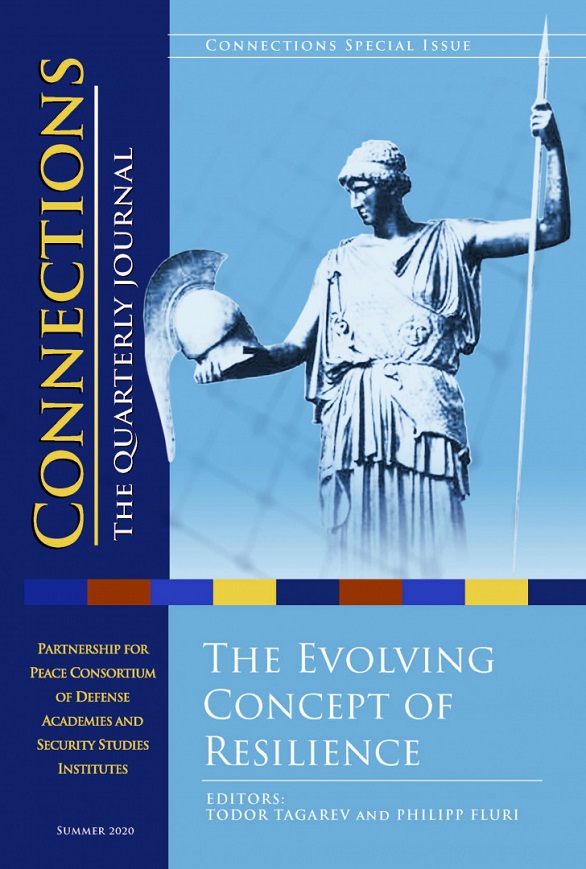
Aiming for a more effective and efficient response to diverse and multidimensional threats, an increasing number of defense and security organizations, the United Nations, NATO, and the EU embrace the concept of resilience in their security strategies and policies. This article provides a brief overview of the concept, a sample of definitions used in policy documents, and the types of problems they seek to resolve. Then we introduce the reader to the 15 articles published in the Summer and Fall 2020 issues of Connections that present the evolution of the concept of resilience and its implementation by and within political, defense, and law enforcement organizations, as well as its anticipated contribution to cybersecurity, disaster preparedness, peacebuilding, post-conflict restoration and countering hybrid threats.
In recent years, the notion of resilience has experienced an astonishing expansion away from the area of its original application and transformation of its meaning. Originally it denoted the aptitude of material (objects and substances) bent, stretched, twisted, or compressed to spring back into the original form – in mechanics, the work required to strain an elastic body to the elastic limit and “the work performed by the body in recovering from such strain.” In psychological and medical contexts, it was then used metaphorically in cases of illness and setbacks to describe the psychological quality that allows people to be “knocked down by the adversities of life and come back at least as strong as before.
Previous Issue
 The Winter 2016 issue of Connections presents original articles on Russia's hybrid warfare toolset and its Soviet predecessors, the crisis in Ukraine, caused by the annexation of Crimea and the Kremlin-backed separatist forces in South-Eastern Ukraine, the enduring validity of Clausewitz's "On War" for modern conflict, and a review of university pr...
Read More
The Winter 2016 issue of Connections presents original articles on Russia's hybrid warfare toolset and its Soviet predecessors, the crisis in Ukraine, caused by the annexation of Crimea and the Kremlin-backed separatist forces in South-Eastern Ukraine, the enduring validity of Clausewitz's "On War" for modern conflict, and a review of university pr...
Read More