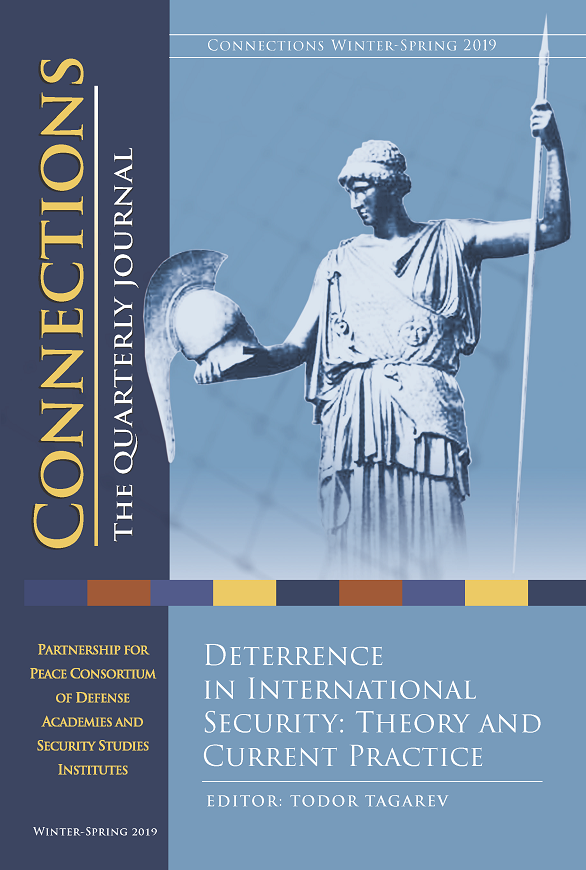
Connections
Contents
Emerging Security Challenges: An Introduction
Policy and the Internet of Things
Industry and Policy: Partnerships in Disruptive Times
Nanotechnology and Global Security
Hybrid Warfare and the Changing Character of Conflict
Making Sense of Hybrid Warfare
Abstract:
Serbia, the largest country of the Western Balkans, faces a historical choice concerning its future political orientation. Although this choice has been on the agenda since the late 1990s, it will remain unresolved for some time to come. The country’s transformation has been moving forward. However, short of integration in western institutions, first of all in the European Union, the process is incomplete and other major players in the international system, first of all Russia but to some extent also China, attempt to influence Belgrade in a direction favorable to their interest. Rational choices in regard to economic integration, trade and investment, and the effects of consolidating democracy should drive Serbia in the direction of the West. However, as demonstrated by some cases, there are factors other than rational choice. Emotional association with Russia, orthodox Christianity, the Russian backing of Serbia in the dispute of the latter with Kosovo, as well as Moscow’s sophisticated influence playing on the West’s step-by-step advancement and hesitation help Russia better establish itself in Serbia. That results in an inconclusive situation that requires attention to avoid the continuation of hesitancy and uncertainty in the long run. China potentially offers an alternative, primarily as a trade partner and investor. However, its interests in Serbia’s future orientation may be different from Moscow’s as its investments may offer higher returns if Belgrade becomes a member of the European Union sooner rather than later.
Previous Issue
 The Winter 2016 issue of Connections presents original articles on Russia's hybrid warfare toolset and its Soviet predecessors, the crisis in Ukraine, caused by the annexation of Crimea and the Kremlin-backed separatist forces in South-Eastern Ukraine, the enduring validity of Clausewitz's "On War" for modern conflict, and a review of university pr...
Read More
The Winter 2016 issue of Connections presents original articles on Russia's hybrid warfare toolset and its Soviet predecessors, the crisis in Ukraine, caused by the annexation of Crimea and the Kremlin-backed separatist forces in South-Eastern Ukraine, the enduring validity of Clausewitz's "On War" for modern conflict, and a review of university pr...
Read More