Connections
Contents
Karachi: Organized Crime in a Key Megacity
Global Dimensions of Organized Crime and Ways of Preventing Threats at International Level
Transnational Organized Crime – Latvian Challenges and Responses
Maritime Piracy as a Form of Organized Crime: A Strategic Management Approach
Cyberspace as the Environment Affected by Organized Crime Activity
The Mobilization and Recruitment of Foreign Fighters: The Case of Islamic State, 2012–2014
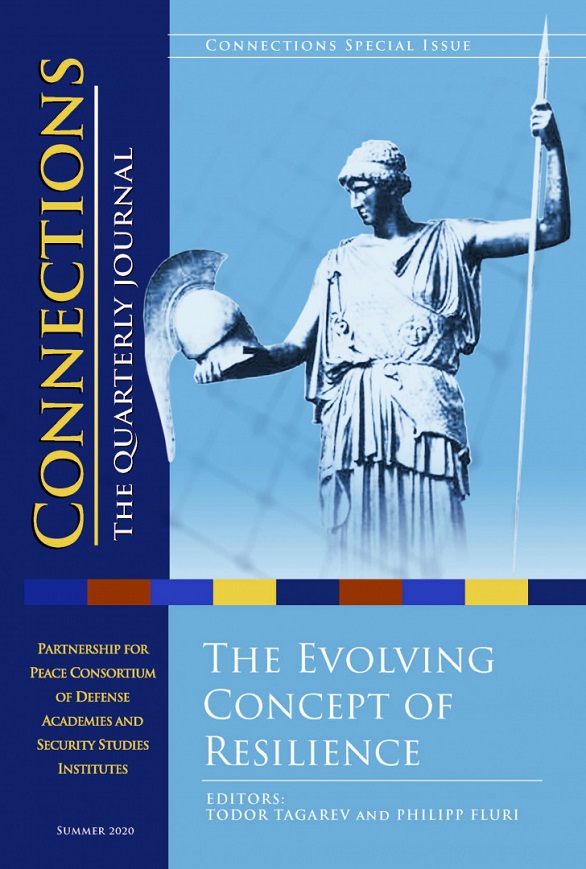
The concept of resilience has roots in many disciplines, making the pursuit of a unified theory very attractive but also very difficult. Yet this has not stopped scholars and politicians from attempting to claim resilience as their flagship concept and build a canon for the 21st century around it. This tendency to reduce or totalize resilience has spawned a host of taxonomies, each seeking to offer the final word on the definitional debate. I argue that this desire to create a unified theory of resilience misapplies the concept, ignores the dynamics of its emergence and the polysemic nature of its use in theory, policy, and practice. This malleability makes resilience at once both a very attractive logic for dealing with uncertainty and a dangerous pathway towards embedding untempered algorithmic systems of coercive prediction into the governance of everyday life. In understanding the emergence of the resilience concept, one must appreciate both the positive and negative potential of this flexible and adaptive notion. I close by suggesting that resilience has gained such traction in recent years in no small part because it represents a shift in the onto-politics of our time, but that we must be careful about which type of resilience gets enacted.
Previous Issue
 Advances in sensors, communications, computing, nano- and bio-technologies, along with new strategies and operational concepts, challenge our policy-making capacity. The Spring 2016 issue of Connections presents the Emerging Security Challenges Working Group of the PfP Consortium and reflections of some of its members on the security and policy imp...
Read More
Advances in sensors, communications, computing, nano- and bio-technologies, along with new strategies and operational concepts, challenge our policy-making capacity. The Spring 2016 issue of Connections presents the Emerging Security Challenges Working Group of the PfP Consortium and reflections of some of its members on the security and policy imp...
Read More