Connections
Contents
Karachi: Organized Crime in a Key Megacity
Global Dimensions of Organized Crime and Ways of Preventing Threats at International Level
Transnational Organized Crime – Latvian Challenges and Responses
Maritime Piracy as a Form of Organized Crime: A Strategic Management Approach
Cyberspace as the Environment Affected by Organized Crime Activity
The Mobilization and Recruitment of Foreign Fighters: The Case of Islamic State, 2012–2014
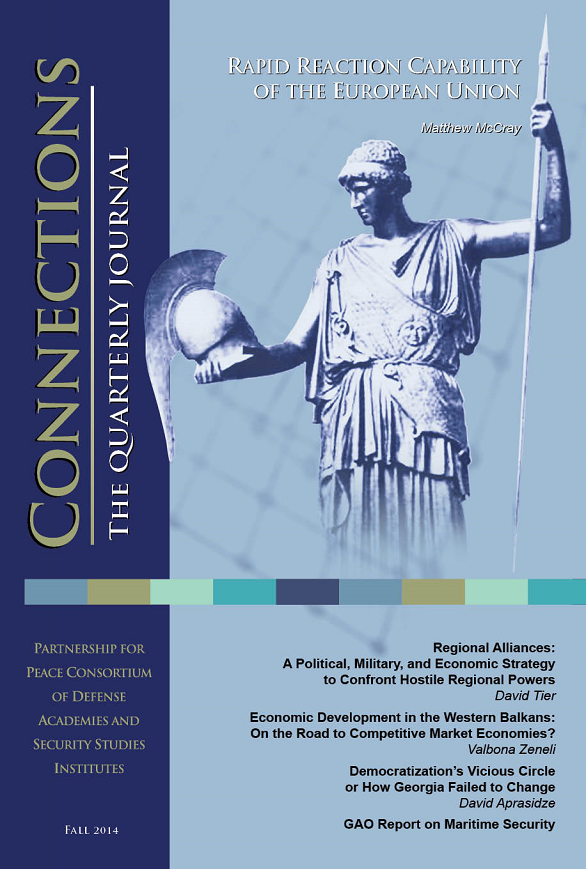
Georgia’s first peaceful transition of power, through the parliamentary elections in 2012, has been celebrated as an important achievement in the democratization of the country. At the same time, the new government has initiated several high-profile criminal cases against representatives of the former government, including the president and the prime minister, creating solid bases for critical assessment of further prospects for the democratic consolidation of Georgia. The new government has signed an Association Agreement with the EU – an important test to prove Georgia’s pro-Western orientation and dismantle speculations about pro-Russian sentiments of the new ruling elite. Nevertheless, how the political change in leadership might impact the external relations of Georgia remains to be seen.
Previous Issue
 Advances in sensors, communications, computing, nano- and bio-technologies, along with new strategies and operational concepts, challenge our policy-making capacity. The Spring 2016 issue of Connections presents the Emerging Security Challenges Working Group of the PfP Consortium and reflections of some of its members on the security and policy imp...
Read More
Advances in sensors, communications, computing, nano- and bio-technologies, along with new strategies and operational concepts, challenge our policy-making capacity. The Spring 2016 issue of Connections presents the Emerging Security Challenges Working Group of the PfP Consortium and reflections of some of its members on the security and policy imp...
Read More