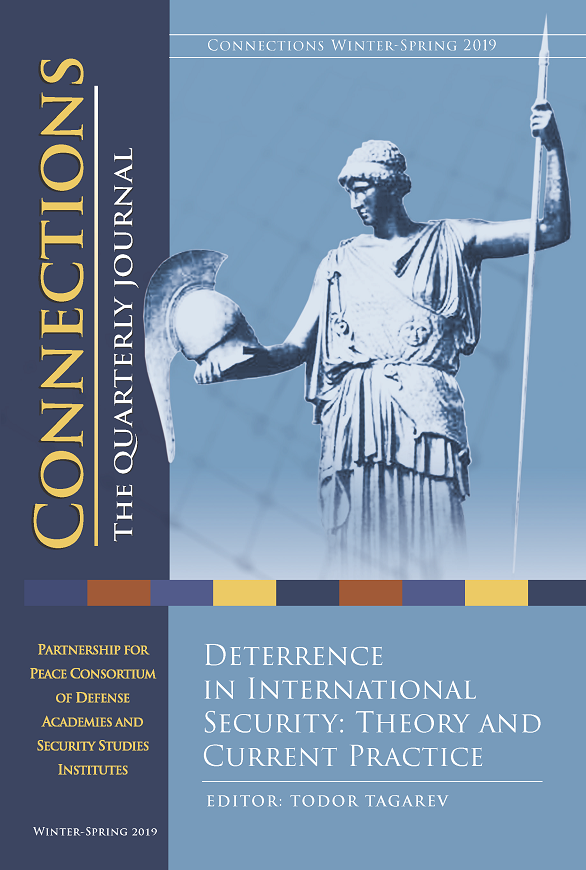
Connections
Contents
Karachi: Organized Crime in a Key Megacity
Global Dimensions of Organized Crime and Ways of Preventing Threats at International Level
Transnational Organized Crime – Latvian Challenges and Responses
Maritime Piracy as a Form of Organized Crime: A Strategic Management Approach
Cyberspace as the Environment Affected by Organized Crime Activity
The Mobilization and Recruitment of Foreign Fighters: The Case of Islamic State, 2012–2014
Abstract:
Cyberspace as the fifth domain is omnipresent, and all developed states increasingly realize that international relations and typical domains of statehood change in the face of global digitization. With the advent of game-changing technologies, traditional statecraft tools, such as deterrence, seem disregarded as outdated in the national security strategy building process. Advanced states, in particular, depend heavily on an open and safe cyber domain but, at the same time, suffer from manifold vulnerabilities. The recent past showed that sophisticated cyberattacks have the potential to disrupt governments, economies, and societies significantly and therefore pose a threat to core security interests. As a classical tool in international relations, deterrence can help bolster national security interests, even if the cyber domain requires some special considerations. Therefore, the article explains the basic mechanisms of deterrence in the nuclear age and contemporary international relations, cyberspace’s legal framework, and possible ways to apply deterrence in the cyber domain. It aims to urge global leaders to thoroughly consider deterrence in the cyber domain as a powerful asset and to provide policymakers with options for action.
Previous Issue
 Advances in sensors, communications, computing, nano- and bio-technologies, along with new strategies and operational concepts, challenge our policy-making capacity. The Spring 2016 issue of Connections presents the Emerging Security Challenges Working Group of the PfP Consortium and reflections of some of its members on the security and policy imp...
Read More
Advances in sensors, communications, computing, nano- and bio-technologies, along with new strategies and operational concepts, challenge our policy-making capacity. The Spring 2016 issue of Connections presents the Emerging Security Challenges Working Group of the PfP Consortium and reflections of some of its members on the security and policy imp...
Read More